
If you need to replace the end of an electrical cord, here are some things you need to know.
2 or 3 Prongs?
- Some plugs have two prongs while others have three prongs.
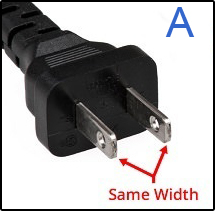
- Picture A has two prongs of equal size.
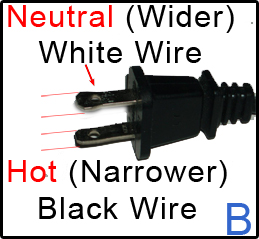
- Picture B has two prongs where one prong is wider than the other.
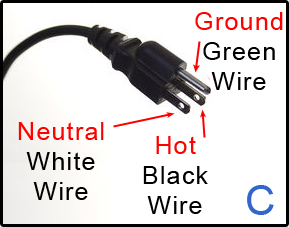
- Picture C has three prongs.
- It’s important to replace a bad plug with a new one that is the same type that the old one was.
Polarized Prongs?
- Picture A is a non-polarized plug which can be inserted into a wall outlet in either direction It does not matter which wire connects to each prong.
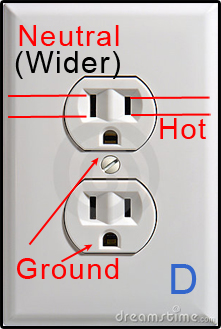
- Picture B is a polarized plug and can only be inserted in one way because of the wider prong – see the outlet in Picture D.
- The wider prong connects to the neutral wire which is usually white and the smaller prong connects to the hot wire – usually black.
- It’s very important to connect the wires to the proper prong. Picture C – the three prong plug has a ground wire (green) in addition to the hot and neutral wires. It’s also very important to connect these wires to the proper prong.
Safety First
If you’re replacing the end of an electrical cord you will want to make sure it isn’t plugged in! That will be obvious if you’re replacing the end that plugs into the wall outlet – but if you’re working on the other end make doubly sure it’s not plugged in.
Above we discussed polarized and non-polarized cord ends. If you’re replacing either end of a polarized cord here are some things to be very aware of. 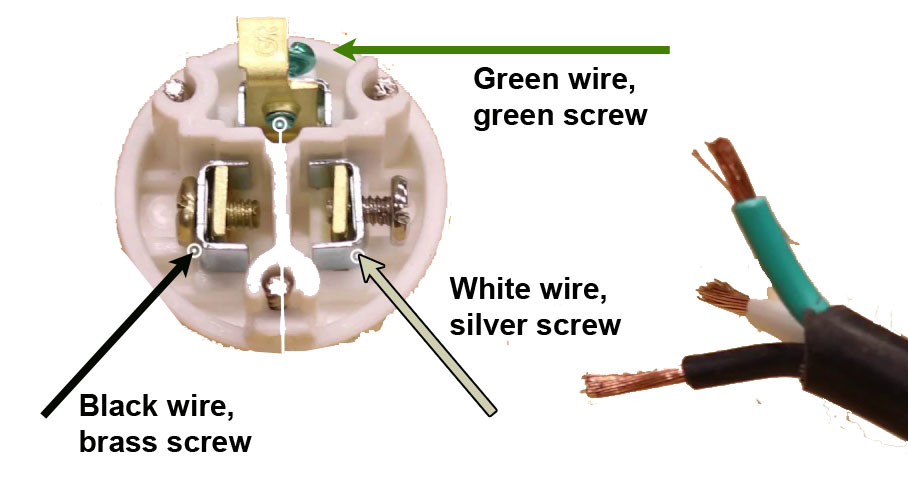
- The screws where the wires connect are colour coded.
- The silver screw is where the neutral (white) wire connects.
- The brass screw is where the hot (black) wire connects
- The green screw is where the ground (green) wire connects.